How To Choose A Tyre Pressure Routine For Safer Everyday Driving
A practical step-by-step guide to how to choose a tyre-pressure routine for safer everyday driving, including preparation, instructions, common issues, tips, and next steps.
How To Choose A Tyre Pressure Routine For Safer Everyday Driving
Choosing a consistent tyre-pressure routine is one of the most effective ways to improve everyday driving safety, extend tyre life, and enhance fuel efficiency. This guide explains how to establish a simple, reliable method for checking and adjusting your tyre pressures, including when to check, how to use a gauge, and how to adapt for different conditions. By following these steps, you'll reduce the risk of blowouts, uneven wear, and poor handling, and you'll gain peace of mind on every journey.
Fast Answer
- Check your tyre pressures at least once a month and before any long trip, using the manufacturer's recommended figures found in your owner's manual or on the driver's door jamb.
- Make it a habit: pick a consistent day (like the first of the month) and always check pressures when tyres are cold—ideally before driving or after the car has rested for three hours.
Before You Start
- Find your vehicle's recommended tyre pressures: look in the owner's manual, on a sticker on the driver's side door jamb, or inside the fuel filler flap. Do not use the number printed on the tyre sidewall.
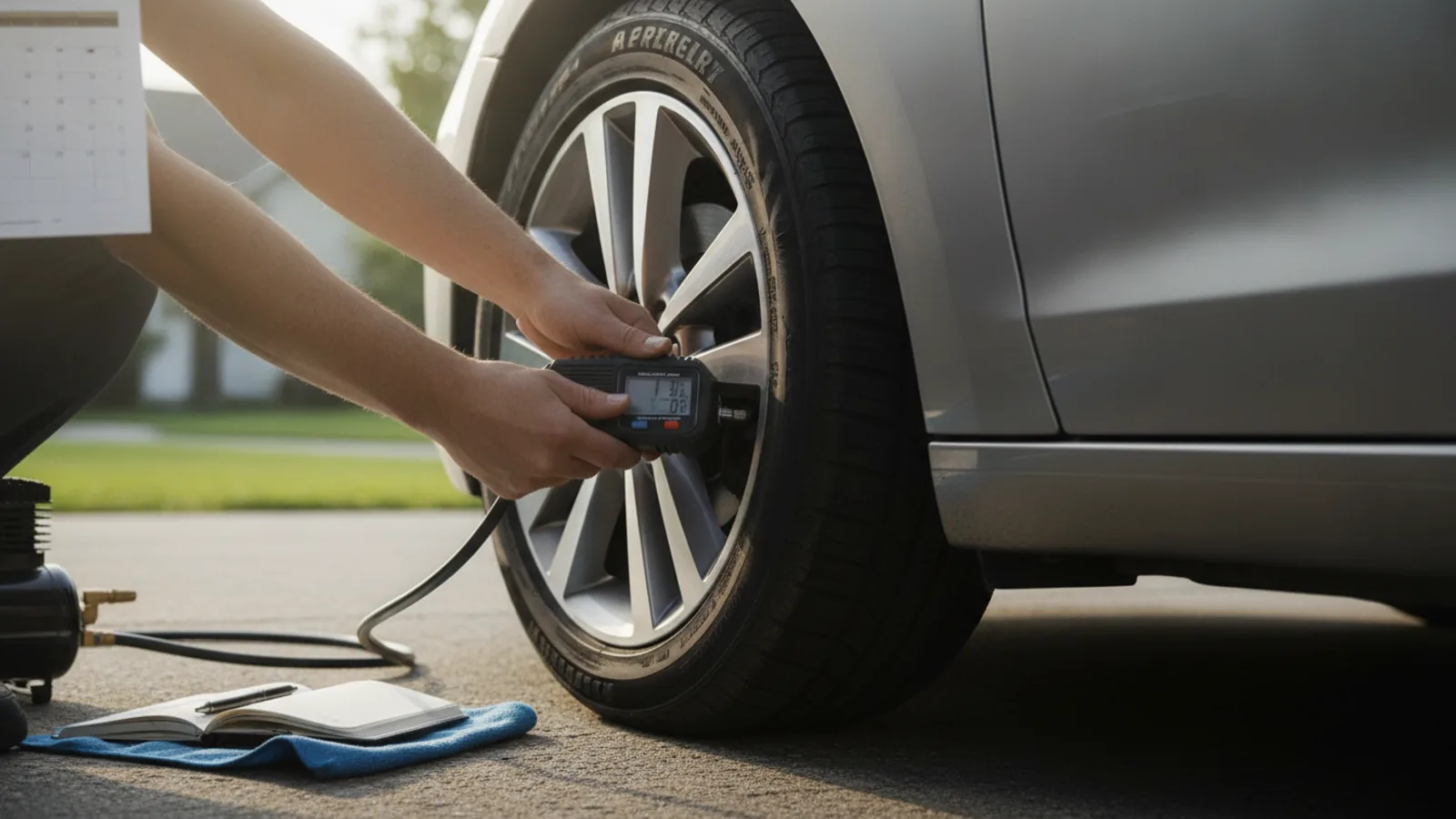
- Get a reliable digital or analogue tyre pressure gauge that reads in PSI or BAR. Avoid relying solely on petrol station gauges, which may be inaccurate or out of order.
- Check the ambient temperature: tyre pressures drop about 1 PSI for every 10°F (5.6°C) drop in temperature, so adjust your expectations accordingly.
- Keep a small notebook or use a notes app on your phone to record each check, noting the date, the pressures, and any adjustments. This helps you spot slow leaks or trends.
Step-by-Step Instructions
Gather Your Tools and Find the Recommended Pressure
Your first step is to know the exact target pressure for your tyres and to have the right equipment at hand. Look for the manufacturer's recommended PSI (pounds per square inch) or BAR figure, which is usually printed on a sticker located on the driver's side door jamb, inside the glovebox, or on the fuel filler flap. This figure is specific to your vehicle's weight and tyre size, and it differs from the maximum pressure stamped on the tyre sidewall. Once you've confirmed the target, ensure you have a good-quality tyre pressure gauge—digital gauges are generally easier to read, but a reliable analogue one works just as well. Also, keep a portable air compressor or know where your nearest air pump is, as you'll need it to adjust pressure if necessary. Before you start, make sure your tyres are cold, meaning the vehicle hasn't been driven for at least three hours or has only been driven a short distance under a mile. This ensures the reading is accurate because driving heats up the tyres and increases pressure. If you've just driven, wait until the tyres cool down to get a true baseline. With your gauge and target pressure in hand, you're ready to proceed with confidence.
Check Each Tyre's Pressure Accurately
Position your vehicle on a level surface and remove the valve cap from the first tyre. Press the gauge firmly onto the valve stem to get a reading—you should hear a slight hiss, but that's just air escaping as you connect; the gauge will settle on a number. Note the reading and compare it to the recommended figure you found earlier. For accurate results, check all four tyres, including the spare if you have one (but only if the manufacturer specifies its pressure). Some vehicles have different pressures for front and rear, so pay attention to that. If the reading is below the target, you'll need to add air; if it's above, you'll need to release some air. Write down each reading for reference. Remember to check tyres when they are cold, as driving even a few miles can raise pressure by several PSI. Also, inspect the valve stem for damage or dirt—a missed cap or a worn stem can cause a slow leak. If you find a valve that looks cracked or is hard to get a reading from, make a note to have it checked by a professional. Accuracy here is crucial because a difference of just a few PSI can affect handling and fuel economy.
Inflate or Deflate to Reach the Recommended Pressure
Once you know which tyres are low or high, you'll need to adjust them. If a tyre is low, attach the air hose from your compressor or a petrol station pump and add air in short bursts of a few seconds, then recheck with your gauge. It's easy to over-inflate, so go slowly and keep checking. If a tyre is over-inflated, press the center pin of the valve with the back of your gauge or a tool to release air in short bursts, then recheck. The goal is to match the exact PSI (or BAR) recommended by the manufacturer for your vehicle. Don't forget to check the spare tyre if your car has one and if the manufacturer provides a pressure figure for it. Spares are often overlooked but can be vital in an emergency. After adjusting all tyres, do a final check on each one to ensure they're consistent. If you had to add a significant amount of air (more than 3-4 PSI), double-check that the valve is seated properly and the cap is screwed on tightly. This helps prevent dirt from entering and causing leaks. Remember: correct pressure is a balance between ride comfort, handling, and tyre life, so it's worth getting it right.
Set a Regular Schedule and Stick to It
The key to a successful tyre-pressure routine is consistency. Tyres naturally lose about 1-2 PSI per month due to permeability, so checking monthly is the minimum recommendation. Choose a specific day that's easy to remember—like the first Saturday of the month—and make it part of your routine, perhaps when you clean your car or before you fill up with fuel. Add a recurring reminder on your phone or write it on a calendar. Also, check pressures before any long trip or when you're carrying heavy loads, as both conditions require adjustments. Record each check in a log: note the date, the pressure of each tyre, and whether you added air. Over time, you'll see patterns—if one tyre consistently loses more pressure than others, that's a sign of a slow leak or a faulty valve, and you should get it inspected. Consistency also helps you catch problems early, saving you from expensive tyre replacement and unsafe driving conditions. By making this a habit, you'll extend the life of your tyres and improve your fuel economy, as under-inflated tyres increase rolling resistance.
Adjust for Seasonal Temperatures and Load Changes
Tyre pressure is directly affected by temperature: as it drops, pressure falls, and as it rises, pressure increases. For every 10°F (5.6°C) change, you'll see roughly a 1 PSI shift. This means your routine should account for the changing seasons. In autumn and winter, when temperatures drop, you'll likely need to add air more often to maintain the recommended pressure. Conversely, in summer, you might notice pressures are higher, and you may need to let some air out. Always check pressures when tyres are cold and the ambient temperature is representative of the season. Additionally, if you plan to carry extra weight—like luggage for a holiday or tools for a job—check your owner's manual for the recommended pressure for loaded conditions; often, rear tyres need a few more PSI. Some vehicles have a separate spec for 'full load'. You should also adjust your pressure if you're going to drive on a motorway for extended periods; higher speeds increase heat and pressure, so ensure tyres are at the correct cold pressure before you start. Ignoring these adjustments can lead to overheating and premature wear.
Inspect Tread and Overall Condition During Each Check
While you're on the ground with the gauge, use the opportunity to visually inspect each tyre. Look for any cuts, bulges, cracks, or embedded objects like nails or stones. These can cause blowouts or slow leaks, and catching them early can save a tyre and prevent an accident. Check the tread depth using the 'penny test': insert a 1p coin into the tread with the Queen's head down; if you can see the top of the head, your tread is below the legal limit of 1.6mm and you need new tyres. Also, feel the tread for any uneven wear—if one edge is more worn than the other, it could indicate misalignment, incorrect pressure, or suspension issues. Look at the sidewalls for dry rot or cracks. If you notice any of these problems, do not just inflate and continue; have a professional assess the tyre. Regular inspection also helps you understand how your driving habits affect tyre wear. For instance, aggressive driving or frequent hard braking will wear tyres faster. By combining pressure checks with a visual inspection, you create a comprehensive care routine that ensures your tyres are always in safe condition.
Quick Reference
| Situation | Action | Why it helps |
|---|---|---|
| Checking for the first time and unsure where to find the recommended PSI | Look in the owner's manual first, then check the driver's door jamb sticker, the glovebox, or the fuel filler flap; never use the number on the tyre sidewall. | The sidewall number is the maximum pressure the tyre can hold, not the manufacturer's recommendation for your vehicle's weight and handling. |
| During a cold snap, when temperatures drop below 0°C overnight, and your tyre pressure warning light comes on | Wait until your tyres are cold, then check all pressures; if the reading is low by 3 PSI or more, add air to meet the recommended cold pressure. | Cold air contracts and reduces pressure, so the drop you're seeing is natural; topping up to the spec keeps handling safe and avoids false warning triggers. |
| Packing the car for a family road trip and the boot is full of luggage, increasing rear axle load | Consult your owner's manual for the 'full load' rear pressure, then adjust the rear tyres to that higher setting before setting off; don't forget to re-check front tyres too. | Extra weight increases heat and flex in the rear tyres; a slightly higher pressure prevents excessive squat, reduces rolling resistance, and improves stability at speed. |
Common Issues
- Tyre pressure warning light comes on frequently, but after checking, all tyres seem near the correct pressure.: Reset the TPMS per your owner's manual, then recheck pressures after a day. If the light returns, it may be a faulty sensor or a slow leak; have a professional diagnose it, as driving with a malfunctioning TPMS can lead to under-inflation without warning.
- One tyre loses 5-6 PSI every week, but you can't see any obvious damage.: Apply soapy water to the valve stem and the tire surface; look for bubbles indicating a leak. If the valve is fine, remove the wheel and inspect the inner side for tiny punctures or a cracked bead. Take it to a repair shop to have it patched or sealed professionally, rather than just inflating repeatedly.
- Tyres wear faster on the outer edges, even though you've been maintaining the recommended pressure.: This often indicates under-inflation, but if pressures are correct, it might be a suspension alignment issue. Have your wheel alignment checked by a professional, and also ask them to measure your toe and camber angles. Correct alignment will even out wear and improve handling.
Advanced Tips
- Use nitrogen instead of air if you have easy access; nitrogen molecules are larger than oxygen, so they escape more slowly through the tyre liner, which means pressures stay stable for longer, especially in fluctuating temperatures. However, it's not essential for the average driver.
- If you regularly tow a trailer or carry heavy loads, consider creating a separate pressure log with two settings: 'normal' and 'loaded'. That way, you'll have clear figures to switch between without having to recalculate each time.
- To extend the life of your valve stems, always put the dust cap back on tightly after checking. A missing cap allows dirt and moisture in, which can corrode the valve core and lead to slow leaks.
Final Checklist
- Check all four tyres (plus spare) at least once a month using a gauge you trust.
- Always compare your readings with the manufacturer's figures from the manual or door jamb, not the tyre sidewall.
- Adjust pressures only when tyres are cold, and recheck after adding or releasing air to avoid over-inflation.
- Inspect tread depth and tyre sides for damage during each pressure check, and take any anomalies to a professional.
FAQ
How often should I really check my tyre pressure?
You should check at least once a month, because tyres naturally lose about 1-2 PSI each month. Additionally, check before any long trip, when you carry heavy loads, or if you notice any change in handling, such as pulling to one side or a thumping sound. Seasonal temperature changes also warrant extra checks, as a drop of 10°F can reduce pressure by 1 PSI. Setting a regular day, like the 1st of the month, makes it a habit and ensures consistency.
Can I use the pressure number printed on the tyre sidewall?
No, you should never use the number on the tyre sidewall as your target. That number is the maximum safe pressure that the tyre can handle, not what your vehicle needs. The correct pressure depends on your vehicle's weight, tyre size, and design, and is determined by the vehicle manufacturer. You'll find it on a sticker in the driver's door jamb, in the glovebox, or in the owner's manual. Using the sidewall number could lead to over-inflation, reducing grip and causing uneven wear.
What should I do if my tyre pressure gauge gives a different reading than the pump's gauge?
Trust your own gauge, provided it's in good condition and you're using it correctly. Public pump gauges are often inaccurate, damaged, or poorly calibrated. To ensure your gauge is reliable, you can test it against a known accurate gauge at a reputable garage or replace it every couple of years. If you notice a significant discrepancy, you can also check your user manual for gauge accuracy, but it's best to invest in a digital gauge known for consistency.